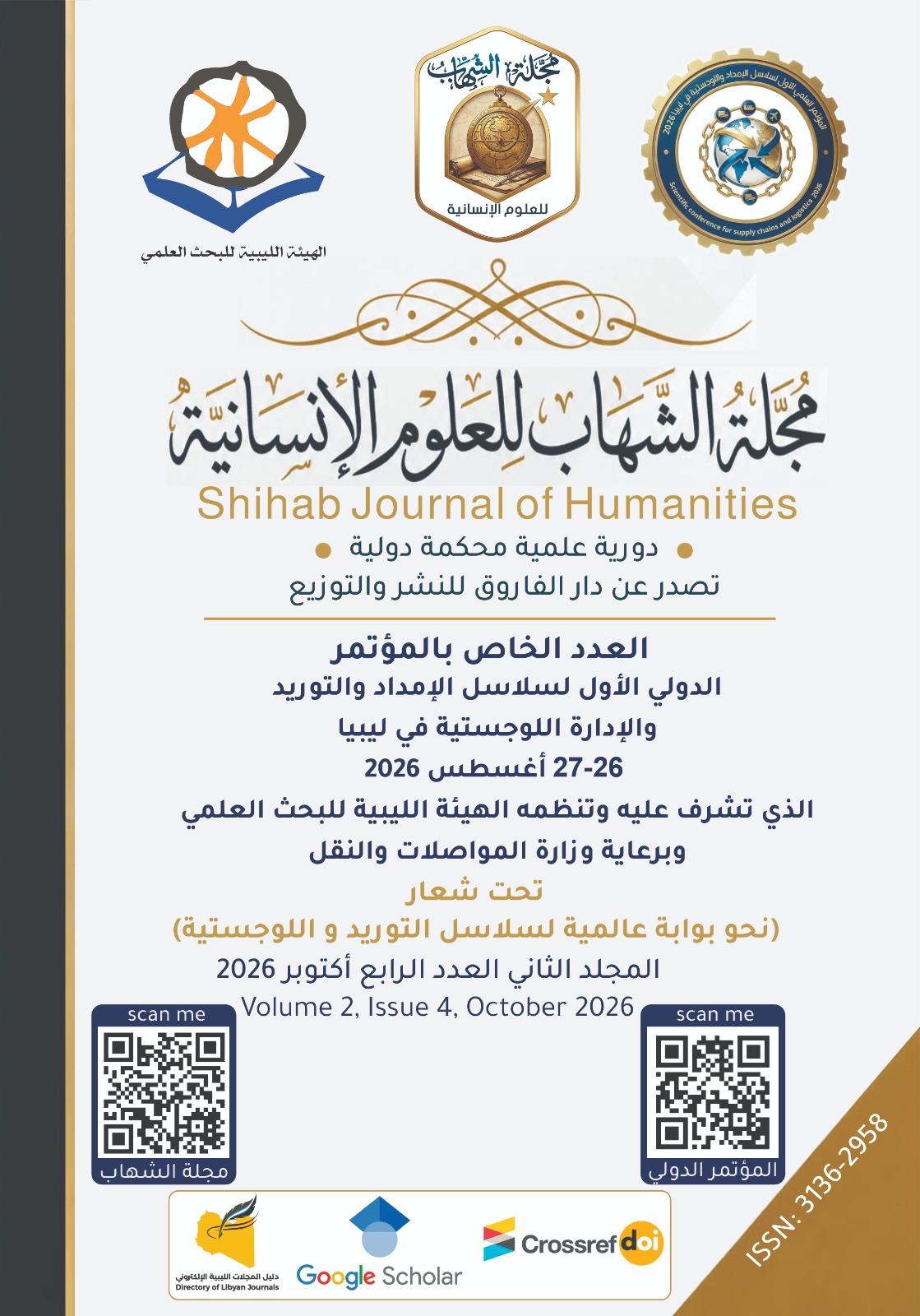
Applications of Artificial Intelligence in Supply Chain Management and Their Impact on Reducing Logistics Costs
DOI:
https://doi.org/10.65405/sjh.2.4.261Abstract
This study examines the impact of artificial intelligence (AI) applications in supply chain management on reducing logistics costs, through a case study of Samawat Shipping Agencies Company, across four dimensions: demand forecasting, logistics process automation, smart inventory management systems, and big data analytics with transport/distribution efficiency. Using a descriptive-analytical approach, a questionnaire was distributed to the study population (41 employees); 39 valid responses were retrieved (95% response rate), with a Cronbach's Alpha of 0.945. Simple and multiple regression analysis supported the main and four sub-hypotheses, confirming a statistically significant effect (p<0.05) of AI applications on reducing logistics costs (R=0.753, R2=0.568). Descriptive results show the company's actual current adoption of AI remains modest, and the study recommends gradual investment in AI systems linked to strategic planning.
References
Abdelfatah, O. S. M. (2026). Artificial intelligence-driven demand forecasting models for enhancing supply chain planning accuracy in Saudi industrial sectors.
Adesoga, T. O., Ajibaye, T. O., Nwafor, K. C., Imam-Lawal, U. T., & Ikekwere, E. A. (2024). The rise of the smart supply chain: How AI and automation are revolutionizing logistics. International Journal of Science and Research Archive.
Ahmed. (2018). Artificial intelligence: Concepts and applications (p. 33).
Bahloul, & Azzi. (2024). Use of technology in managing logistics services and global supply chains: A prospective analytical study.
Belkhir. (2024). The impact of artificial intelligence use in the supply chain and its role in improving corporate performance: A case study of Amazon (2018-2021).
Ben Turki, Moussi, & Khalidi. (2021). The role of machine learning in improving logistics supply chain management.
Chamli, & Baktache. (2025). The role of artificial intelligence in improving supply chain and logistics services efficiency.
Data Bridge Market Research. (2025). Global logistics market trends report.
Elbachir, I., Nassih, R., & Didast, F. Z. (2024). Artificial intelligence and logistics: Recent trends and development.
Hong, T., Wan, Y., Huang, L., & Zhao, Y. (2025). Applications and challenges of artificial intelligence in international trade. International Journal of Computer Science and Information and Logistics Technology.
Inbound Logistics. (2026, January 8). AI in supply chain management: 2026 outlook.
King Abdulaziz University. (2020). Introduction to artificial intelligence (pp. 8-10).
Kumar, P., Kant, K., Mishra, N., Babu, V., & Chander, N. (2024). AI for optimizing supply chain management. International Journal for Research in Applied Science & Engineering Technology.
Mageto, J. (2022). Current and future trends of information technology and sustainability in logistics outsourcing. Sustainability.
Mermi, M. (2024). Applications of artificial intelligence in warehouse management: Case study of Amazon. Journal of Finance, Investment and Sustainable Development.
NC State University, College of Engineering. (2026, March 17). Supply chain trends for 2025: The impact of artificial intelligence.
Nweje, U., & Taiwo, M. (2025). Leveraging artificial intelligence for predictive supply chain management: Focus on how AI-driven tools are revolutionizing demand forecasting and inventory optimization. International Journal of Science and Research Archive, 14(1), 230-250.
OECD. (2025). AI adoption by small and medium-sized enterprises.
Oo, H. H., Torres, M. M., Abdallah, C., Coelho, R. L. F., Costa, M. M., Hourneaux Junior, F., Cardoso, F. M. C. B., & Sousa, M. M. (2026). Narrow artificial intelligence, supply chain resilience, and SMEs in developing countries: A protocol for a scoping review.
Prajapati, D., et al. (2022). An Internet of Things embedded sustainable supply chain management of B2B e-commerce.
Raja, S., & Venkatachalam, K. (2022). Adoption of digital technology in global third-party logistics services providers: A review of literature.
Refai. (2016). Supply chain management (p. 10).
Sarhan, & Boulahdid. (2024). The use of artificial intelligence in supply chain management in industrial enterprises as an approach to achieving sustainable leadership - The SAP digital supply chain portfolio as a model.
Science Publishing Group. (2026). Artificial intelligence applications and logistics cost control in enterprises: Evidence from Chinese listed companies. American Journal of Management Science and Engineering.
ThroughPut.AI. (2026, May 19). Artificial intelligence (AI) in supply chain and logistics.
University of Jeddah. (n.d.). Supply chain management. https://www.uj.edu.sa
Zaid. (2014). Supply chains: Concepts and applications (p. 627).
Downloads
Published
Issue
Section
License
Copyright (c) 2026 Shihab Journal of Humanities

This work is licensed under a Creative Commons Attribution 4.0 International License.
License
Copyright (c) 2026 Shihab Journal of Humanities

This work is licensed under a Creative Commons Attribution 4.0 International License.